

 Spotify

 Apple Podcasts

 Castro

 RSS Feed
Navigating Life Beyond the Badge with Jessica Flores
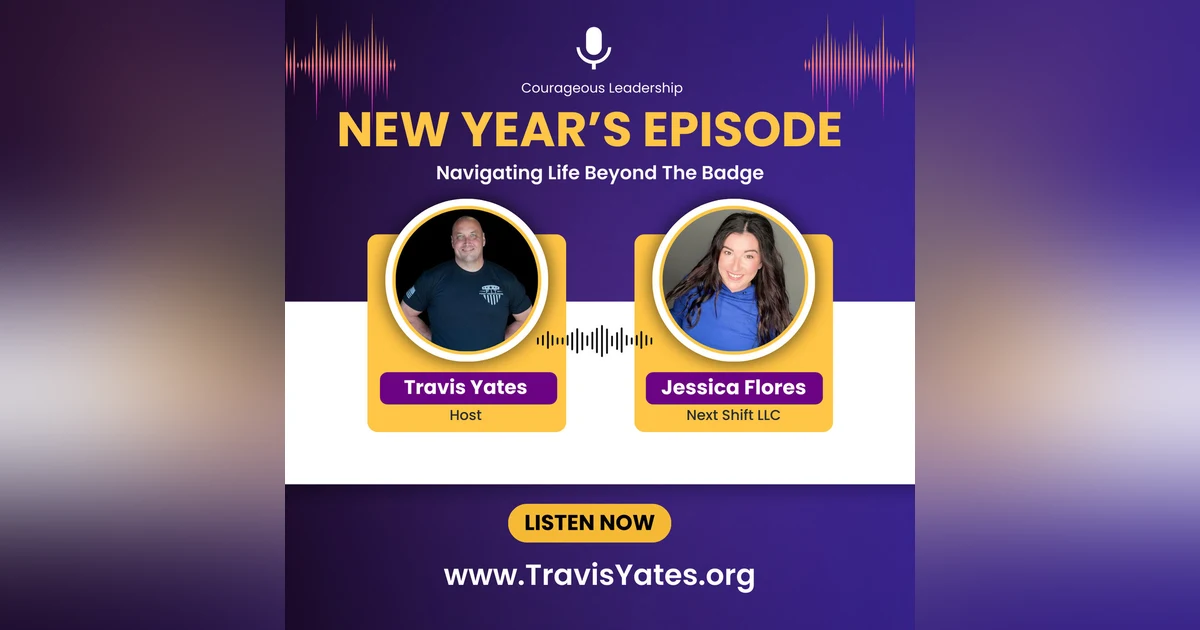

Imagine hanging up your badge after years of dedicated service, only to face the daunting question: what comes next? Jessica Flores, former law enforcement officer turned mindset mentor and transition coach, joins Travis Yates s to unravel the complexities of reinventing oneself post-service. Her insights offer a beacon of hope for those struggling with the "just a cop" mentality, highlighting the necessity of finding a new purpose that transcends the uniform.
Throughout the conversation, we uncover the emotional weight that retirement carries for law enforcement professionals. Jessica's vulnerability in sharing her own transition lays bare the stark reality of losing not only a job but an identity deeply intertwined with public service. We discuss creating a supportive community for officers in transition, the role of monthly debriefs in coping with the loss of camaraderie, and the invaluable guidance in early preparations for retirement—all underscored by the six pillars of wellness.
For any officer facing the crossroads of retirement or change, this episode is an indispensable guide filled with strategies for embracing life's next chapter.
This episode is sponsored by Officer Privacy. OfficerPrivacy.com was started by Pete James, a 25-year veteran of law enforcement and digital forensics expert. His passion is to help LEOs and their families delete their private info from the internet so they can feel safe.
You can contact Jessica on Linkedin here.
The planner Travis discussed can be purchased here.
Join Our Tribe of Courageous Leaders:
Get The Book
Get Weekly Articles by Travis Yates
Join Us At Our Website
Get Our 'Courageous Leadership' Training
Join The Courageous Police Leadership Alliance
00:00 - Law Enforcement Transition Coach
06:16 - Preparing for Life After Law Enforcement
10:03 - Importance of Daily Habits and Self-Structure
18:47 - Transitioning From Law Enforcement
22:21 - The Value For Employers In Hiring Law Enforcement
24:10 - What Leaders Can Do To Help The Transition
0:00 It's a new year and we welcome a new sponsor on the show. I'm a customer. I can't say enough great things about him. But officer privacy. com is owned by law enforcement, ran by law enforcement. It removes your personal information off the top 70 people search Sites out there and if you're out there and you've ever had these random letters from people that had your address and had your name, you know how important this is. It's happened to me before. Don't wait till it's too late. Contact Officer Privacy today Welcome to courageous leadership with Travis Yeats, where leaders find the insights, advice and encouragement they need to lead courageously.
0:46 Welcome back to the show. I'm so thankful that you're joining us here today and this one's going to be a barn burner You're gonna love. Our guest today on the show is Jessica Flores. She's the founder of Next Shift LLC. A former law enforcement professional turned mindset mentor and transition coach, Jessica specializes in guiding people through the uncertainty of life after law enforcement. I love one of her titles is law enforcement Transition coach. Jessica, how are you doing today? I am doing good, Travis. Thank you so much for having me. Well, I I certainly was intrigued by seeing some of your work because it's something I've always talked about. Like Law enforcement gets to the end of their careers so often and then they kind of go now what well, we have typically a pension system where we have folks retiring in their 40s and 50s and there's a lot of now what's what's still around?
1:36 What drove you to this space, to where you're helping law enforcement transition in other careers? Yeah. So I wish I had gotten to the point where I got a pension from my service. But an injury. I took my career very early. I was only 10 years in. This was almost eight years ago now. It's hard to believe, but an injury to my gunhand, and surgery didn't help it. Physical therapy didn't help it and finally the decision to I Can't go back out there at less than a hundred percent, especially with how things have taken a turn over the past several years. So I had to give it up and I sat in a pay party for quite a while because I had that I'm just a cop mindset. I didn't have a couple, I don't have a college degree, and it was all I ever wanted to do, nothing else.
2:23 I was looking at job wise. I was on the job boards every day. Nothing gave me excitement, nothing made me say, ooh, that'll wake me up every morning and make me want to make a difference. And I sat in that for a while. I took plenty of jobs. None of them really had a sense of purpose behind them. And then, a couple of years ago, I was actually at lunch with a friend who was asking me how my job was going and I was like, well, I hate it. I'm so sick and tired of just waking up every day and going through the motions and People had been telling me I should be a life coach. And I was like, what does that even mean? Like who would I talk to? Who would I help? Like I'm just this 30-something year old female with blah blah blah experience. And she told me about a CEO Transition coach that she knew.
3:06 And when I asked her what that was, she told me she basically helps people go from being a CEO To being able to just be a normal person, be at home with your family, how to like communicate with them and how to just be without being in charge and being the boss. And I stopped her in her Trax because I was like, oh my god, I can help x cops through this transition because it sucks. And I did it alone. Most of us Did it alone. Back in that time frame, there weren't as many people out there doing what we're doing today to bring awareness to this topic. Yeah, it certainly is fascinating and you're in a lane that is so important and so vital. You know, jessica, I just retired in July after 30 years and I didn't really.
3:46 I sort of prided myself and I've got other things going on. I have other interests, I focus on my family. I talk to talk right, because I know all the dangers here. Yeah. I gotta tell you you're sucked in, whether you know it or not. There is a transition. You can have all the plans in your head. Most of the trainings on this revolves around finances. We're not seeing officers struggling financially after the job. It's all about what you're saying. I had a purpose, going up every day and going after a mission with a group of cadre of individuals. Now I get up, I don't have that purpose and how and and so, and I don't care how you left the profession. One year is two years injury. You stayed 35, 40 years. You still have to have that purpose because some of the greatest things on this country were Conducted by people with the purpose in late, late in life.
4:33 So kind of expand on the struggles you have with purpose and what you're hearing from others. Yeah, absolutely. So. Initially I became a police officer to be a voice for victims who could either no longer talk because they weren't here anymore or they refused to speak for themselves. And so that was my purpose. Every single I just got these folks I just got to. Every single day I went to work with that mission and that focus and that purpose in mind. When I left my first department, I took a little bit of a break and quickly realized like nope, this is my calling, this is what I'm supposed to be doing. So I went to another department, went to a smaller department, and I immediately made it known that I was gonna be a detective.
5:16 That was the only reason I became a cop. Sure, patrol was fun, but my goal was to be a detective and give that voice to these victims. So a year and a half into that department, I made detective and I loved every minute of it. It gave me a completely new lease on the job itself. It made me learn how to actually I don't want to say how to actually care about the people, but when you're going call to call, you don't have time to stop and really like feel for these people. You just take your report and you move on. But as a detective you take ownership of that case because now it's yours. And that was an interesting time period. But I also saw a need for some leadership on her department and I was like, well, I guess I'm gonna go for that.
5:57 So I did that. And then I did a sergeant for about a year and a half before my surgery. That got me out of the field and then, like I said, I sat around and like I did these jobs and I was like, okay, well, that going through the motion feeling is not good for any of us. Like you said, you've got to wake up with some kind of purpose to drive what you're doing. And the minute I thought, oh my gosh, I can help X law enforcement, it almost came full circle with I can now give a voice to those who are still in and can't use their voice because of any number of repercussions when you're in a department that you can't say or you can't vocalize, or stigma that's there. But in a one on one setting, when I'm talking with people they feel comfortable to share, or even when I host I just started hosting a monthly debrief event for both current and former law enforcement to show up and have these discussions in a safe place where it's just us.
6:50 We're talking through some of the things we've been through, some of the things we're feeling, some of the things we've dealt with Post transition, and it's just been really insightful to see what people are saying and, like you said, camaraderie and community is one of the biggest things people miss, as well as that sense of mission and purpose. Some people go straight into another law enforcement type role and that's great. That's very, very comfortable, but it's not always for everybody. Some people are getting out of this field right now just super pissed off and super burned out and then thinking that it's going to get better when they go to a similar role in the private sector. And my mission and my goal is to help you really figure out and remember who you are behind that badge, so that you have a world of possibilities, because there are so many opportunities out here in this world.
7:41 If you look at my bio, you'll see that my mission is to help you rediscover your identity beyond the badge to be, redefine your purpose what does it look like after law enforcement? And then reignite the passions that you probably set aside while you were in your career because you were too busy working and sleeping, and working and sleeping and just really seeing the shit of the world. And that's my goal to bring all that back and help you remember who you are and decide what direction you actually want to go, not just the one that seems logical. Yeah, I think that's why I've often been befuddled. I'll see a guy that's retired or a guy that's retired 30, 35 years, 20, 25 years and then they end up being a bank security guard or they end up going to another police department and I never really understood that until I retired.
8:24 And there is a big gaping hole in that area, because law enforcement is very camaraderie and mission and orient. I mean, it's all this sort of structured environment. Even when you go to work, certain times you got to be here or squad meetings, or you got to do this, you got to do that, and then all of a sudden you wake up without that structure. And I don't want to say it's like prison, but you know people get in prison and they get used to the structure. When they get out of prison they really struggle with recidivism because they kind of like the structure. So what are some tips? And I want to say some tips let's start with before you retire, because this needs to be, you need to be prepared long before you retire for some of these issues. What are some tips you would give to somebody still on the job is knowing a year, two, three years out, they're going to be retiring.
9:10 The biggest thing I keep saying and I think I've said it on every one of my latest episodes is prepare today like it ends tomorrow, because you never know. I mean, we all know that life can change in an instant. We all know that tomorrow is not promised, so it's great to be like, yes, retirement is three years, five years, 10 years out, but we have to be realistic and understanding we might not make it to that. So, whatever choices you're making today, whoever you're choosing not to spend your time with, aka your family that's suffering, if you're choosing to just keep work, work, working, working, you've got to prepare, and I actually just created and launched preparing for life after law enforcement as a course using the six pillars of wellness to help people think about these areas of their life that they really need to have in order, in order to make this transition less difficult and less hurtful.
10:03 Well, I know you talk about daily habits, a lot and structures, and I found that the more I structure my days without, without the man telling what to do, the better off I am, because I think at our core, if we don't structure our day, we sort of get lost in that right. So to this. The first we're actually filming this on the first day of the year is not going to come out for about a week, but so this early in the year, for everybody listening and I see all these daily planners. I'll admit I've got one. Last year's went untouched, but this year I have a different plan and you know each week it's got your goals for the week and what you're going to do each day and all this stuff, or something like that, is that. Are there any other tools, resources in addition to that that can help that you could recommend folks? Absolutely, and I recommend keeping it simple.
10:45 I just did some stories earlier today where I was like when we try to overhaul our entire life and one day or one night, because magically, this clock struck midnight. We set ourselves up for failure back in 2018, so it was two years post getting out of law enforcement. I came across Rachel Hollis and she had this five to thrive that she had in this daily notebook of hers, and she had some other things that went with it, but those, those things are the ones that stuck with me most. So I created a daily habit tracker that is at the link in my bio on both LinkedIn and Instagram that people can grab, and I give you the first set of five things to do every day to help you thrive.
11:25 But then I give you the option to then take okay, well, after this, what habits did I like? Which ones did I not like? Which would I rather put here? Which would I rather not? And they're very, very simple things, at least to me, and again, you try to do them every day. We're not gonna be perfect. Sometimes it'll show you when you look back and you're like, wow, there's one habit that I am just really not hitting any day. For me, that was my food. My nutrition was definitely off, but all of the other ones I basically got almost every day, so it can really show you where you need to lean into. But the five habits that she utilized were waking up an hour before you need to so that you're not rushed, you have time for yourself, you can do whatever you need to in that time.
12:08 Coffee and quiet time. Ice tower that's a hot thing right now. Some meditation or prayer, reading a book, some sort of personal development. But waking up that hour before you need to so you have time to woo-saw before the day gets started. Making sure you have at least half your body weight announces a water a day, help flush some of that dunk out of our systems. A food plan that one I just leave up to people. You pick a food plan and you follow it so that you have some sort of structure in regard to your nutrition. A workout and for that? For the longest time I thought a workout was in the gym heavy lifting, sweating, at least an hour of my day, and that is just not how I feel anymore.
12:52 Intentional movement every single day, at least 20 minutes of it. That is something we can all find time for, whether that's a walk, jumping on a trampoline, two 10-minute walks around the block, dancing, actual weightlifting, going to the gym. Whatever it is 20 minutes of intentional movement with your body a day. And then gratitude, which is probably my number one thing. When we focus on what we are grateful for, it just seems to multiply, and every single morning I will write down five things I'm grateful for, and they can be as small as how good my coffee smells, that I'm getting to enjoy it in peace and quiet, that the birds are singing outside, my husband made it home from work safe last night to anything big, oh my gosh.
13:35 We got married, or we sold our house, or I got a promotion. But if we constantly wait for that next big thing to happen, we spend a lot of time just feeling funky and blah when we can celebrate the little things that happen every day that we take for granted, for goodness sakes, waking up to something we should be grateful for because, again, it's not promised. So gratitude is one of those things that, if you can instill that in at least your morning, but some people maybe at night before you go to bed, so you have a positive note. Or even if I'm having a bad day and I'm really in my head and I can't seem to get out of it, I will stop what I'm doing and write down five things I'm grateful for. To smack me back to reality. Yeah, that gratitude is important.
14:16 I don't have my planner in front of me, I was just broke it open last night. I'll have to. I'll put that link to that, this particular planner, in the show notes. But gratitude on a daily basis is a list they have on there where you get up every day and it talks about just what you said meditation. Gratitude has a list for your diet, nutrition, all this stuff. So I want to give some encouragement to people that maybe they've retired, they've kind of gone through this transition we're talking about and I will tell you, until you've done it, you don't know what it is. You may think you know what it is, but you don't, because you're probably further into that profession and all the things that come with it than you think you are because you've been around it so long. But there's something to be said about. Yes, you had a structure working for somebody that told you what to do versus now.
15:01 You have a similar structure, but you're the boss, right, jessica? You tell yourself what to do in the day and if you can get that down, that's a pretty powerful thing. Because here's a hint, you know, post six months retirement, you get a lot more done in the day when you're working for yourself than the distractions of working for somebody else and all the things that come during that day. So, jessica, the idea of just writing things down to structure your day, how powerful is that. It's incredibly powerful, and this is where I used to be a perfectionist and everything had to look like what somebody else had already done. But I have since learned that making things your own is really what's gonna help you thrive here. So just because these habits might work for you or these habits might work for me, doesn't mean they're gonna work for the next person.
15:47 So you really have to develop what your own habits look like each day, what your own routine looks like each day. But writing it down. It's almost like what is the saying when they say a goal not written down is just a dream. No, if you have a goal for something, write it down and then work through that, work yourself backwards and figure out what the steps are you have to take, who you have to become in order to get there. So it's the same exact thing, and me personally, I'm not a person who can look at a calendar and have every single hour of every day lined out. That gives me so much anxiety that if it's not perfect, then I'm gonna fail and my mindset can't wrap around that. But if I personally just have a list of here are the things I have to get done today and then a list of things I would like to get done today.
16:34 That's a whole lot easier for me personally to wrap my brain around and I can cross them off as they go and I'm not that person who writes things like brush my teeth down just so I can cross something off. But if you are and that's what helps get you started on this path then that's what you need to do. If you're just joining us, we're talking to Jessica Flores. She's a law enforcement transition coach, very much needed today. And, jessica, you talk about transferable skills from law enforcement and I know you have some stuff on your website about that, so explain to that. So I think in law enforcement we, almost because of the structure, we're told all we can be as a cop. I mean, there's nobody that really thinks outside that box because of just the environment you're in when you do it.
17:18 People that aren't an officer don't understand this. But just imagine going to an accounting office and everybody around you goes well, you're just an accountant, you're just an accountant. After a while you're gonna think all you can be as an accountant. But I think you've rightfully nailed this here when you said there's a lot of possibilities out there. So how do you get someone out of that mindset? When you talk to them and think and they can't do anything else, where do you start? Yeah, so we start with the conversation and I remind everybody, whether it's on a podcast or in person in an interview or coaching session, that you are more than just a cop. We just have to get you to remind yourself of that because, like you said, for years we've been told or at least made to feel like that is all we can do. So when we start talking, we just talk.
18:00 Who are you Like? Tell me a little bit about yourself. Typically, people start with anything while enforcement related and I have to stop them and be like that's great, I appreciate that. But who are you outside of the job? Tell me a little bit about that. What do you enjoy doing? Who do you enjoy spending time with? And I will tell you that it's been almost heartbreaking lately for a few people that I've talked to and they're like I don't associate with anybody. That's not a cop, or I don't associate with anybody, or I live in such a rural place there aren't people. And these are again all excuses that we're telling ourselves, because the internet has billions of people on it and it is full of people from across the globe and full of people who are similar to us, people who are different than us but can give a different perspective than us, and it has been One of the most eye-opening things.
18:47 Usually in law enforcement we don't utilize social media Just nature of the job. But I will tell you that every single person who is an officer needs to at least be on LinkedIn. I wish I got paid to say that because I say it so much, but you've got to be on LinkedIn and you've got to make these connections, whether you're connecting with people in the field still who just can relate to you, or people who have Transitioned and there is a whole wide network of us out here who have already transitioned and doing all sorts of different things, and I have yet to meet someone who will not stop what they're doing and have a conversation with you about what their transition was like and what life after law enforcement looks like for them. So get yourself on there and just start engaging in content.
19:27 If you're not ready to reach out, that's fine. It takes time, but if you can reach out to these people who make a post that really speaks to you in some way and have a conversation with them, it's part of getting yourself prepared and building your network for when the end of your career does come. You have this network of people, but a couple exercises I like to have people do. I'm a big list person, so I like to have you make a list of all of the things. You are kind of put I am at the top and then list I am a daughter, I am a wife, I am a cap. You know all of the things that you are. I am confident, or maybe you're struggling, I am struggling, whatever it is that you are feeling, I am applies, to put that in your column. And then I want you to make a list of everything that gives you a sense of purpose.
20:12 It's probably gonna be, if you're still in the field, very much job related, but maybe it's serving at church, maybe it's volunteering on the weekends or your days off, maybe it is Taking your kids to sports practices or coaching their sports team, whatever it is, but things that make you feel purposeful and grounded. Put that in that list. And then I want you to make another list of All the things that bring you joy and that you enjoy doing. And this one is really hard for a lot of people right now that I'm talking to again. They're kind of in that disgruntled, burned-out stage of their career, but nothing brings me joy and I'm just like that's not true. What are things that you enjoy? Is it a movie? Is it a activity? Is it a person? Is it?
20:52 You really have to dig deep and we're all I don't want to say we're all a lot of times we're very surface level. We don't give ourselves the ability to dig deep. So on each of these lists I'm like hey, do give yourself 15 minutes or so, turn on whatever music helps you think and feel calm and relaxed and Just let it out. Let it go on the piece of paper. Even if it doesn't make sense right now, get it out on the piece of paper so you can look at that and you can see it and then hopefully we can find something that aligns, maybe even across all three of those where we can start really digging into that and Deciding if that's a route we need to go with your next role. How in demand our ex law enforcement with some of these businesses, because I think we often, you know we get pigeon-holed into we're just a cop.
21:38 But the truth is you've built, no matter who you are inside a profession, you've built certain specialties inside that profession. I mean, I've known cops that have gone to work for insurance companies. Do traffic. You know reconstruction. I've known cops go to work for lawyers doing investigations. You know all kinds of private sector jobs. So how I think I wanted to spell that myth that that they're not wanted because there's a lot of advantages for a company to hire an ex law enforcement officer. And I would agree with you. I will tell you it is definitely not my area of expertise, because I did not take that route. I don't know much about that corporate world. I've made plenty of connections in it and then I I see the job seekers out there and they are saying you know, we're not wanted, whether it's the company is anti law enforcement or they don't think that their skills will be valuable.
22:31 A lot of times that's on us. We have to learn how to translate our skills into what the private sector is looking for. I'm not a resume expert. There are plenty I'm connected with that. I can connect people with. But hooking up with one of them and getting your resume redone or, if that's going to be too much of an expense, utilizing chat, gpt or some AI service to redo your resume, where you upload your resume and you ask them to tweak it to, let's say, a security manager or a traffic investigator for one of those companies. Then again you look at what they do and then you tweak as you need to be tweaked.
23:13 But your number one thing for that type of thing is to get connected with people in that industry that you're wanting to go into. I tell a lot of people look at those people with the title you think you want and then look at all the roles they had before that and all the responsibilities they had before that. Linkedin typically lists all of those things that will help you wrap your head around how what you've done is the exact same as what they've done. They've just worded it differently and now you have the lingo that's needed to get you into that industry. But you've got to reach out to these people and these companies that have jobs like you want. You've got to connect with them. The hiring managers ask the questions, get to know these companies. Don't just think, oh, I want to go into this field or work for this company.
23:57 Really understand why you want to work for that company or in that role, so that you can better explain yourself and sell yourself when it comes time to do so. What opportunity do leaders have inside organizations in law enforcement to prepare people for when they leave, to prepare people for this transition? I can tell you most cops have been lied to. They all talk about the golden bridge at the end of the retirement road. They think that they're going to walk out of their retirement party with cake on their mouth and everything's going to be hunky dory. But that's not always the case. In fact it's rarely the case. So what could leaders do inside organizations to sort of help with this transition? I'm glad you asked that and it's something I've struggled with because when I look at who I talk to and who I want to talk to, it's definitely the people going through this.
24:42 But I have tried to wrap my brain around. How can we get departments to care about this so much? And I've wavered back and forth on man. They're not going to want to tell people how to prepare for what's next or show them how good life can be afterwards, because they need them to stay in the game and they need them there. Now me personally, I want what's best for the people under me. So even if that's not in law enforcement, then it is what it is. I want them to be prepared for what they need to do and what's best for them, and that is just. That is a complete mindset shift from the world that we come from in law enforcement typically because it is. I need you here, I need you in the game. But the more they can be open about their own preparation for what's coming next or their own willingness to bring people like myself in to have either roll call or in service trainings or things like that, the better.
25:38 You've got to have information out there about it. Maybe people won't pick up on it, Maybe they don't care right now, they think they don't need it, but at least that seed is planted in them of oh OK, that's something where I remember hearing about this. Where is that piece of paper? I had Something like that. You've at least got to plant the seed for these people and help them get prepared, Because, again, retirement is one thing, but losing your career without any warning is a complete other disaster of a mindset that people have to struggle through, and that's something that can happen any day. Jessica Flores. Rediscover your identity, redefine your purpose, reignite your passion. Where can our audience find you?
26:19 Thank you so much for having me, and I am mostly on LinkedIn at Jessica. I don't know why it has parentheses with read R E E D, my maiden name, flores, and then I'm also on Instagram, at least for now, and that is at Next Shift. Awesome. Jessica Flores, thank you so much for spending time with us and, if you're listening, thank you for being here. And just remember lead on and stay courageous. Thank you for listening to Courageous Leadership with Travis Yates. We invite you to join other courageous leaders at Travis Yates. org.