Spotify
 Apple Podcasts
 Castro
 RSS Feed
 Decision Tactical: The Future Is Now


Send us Fan Mail If you’ve ever watched bodycam footage and thought, “Why didn’t they just…?”, you already know the hard truth: under extreme stress, the brain does not behave as it does in a classroom. Today we sit down with Remo Eyal, CEO and co-founder of Decision Tactical, to unpack what it really takes to build decision-making under pressure and why immersive scenario-based training has to feel real enough that you forget it’s training. We walk through the research and the physiology be...
If you’ve ever watched bodycam footage and thought, “Why didn’t they just…?”, you already know the hard truth: under extreme stress, the brain does not behave as it does in a classroom. Today we sit down with Remo Eyal, CEO and co-founder of Decision Tactical, to unpack what it really takes to build decision-making under pressure and why immersive scenario-based training has to feel real enough that you forget it’s training.
We walk through the research and the physiology behind performance, from stress inoculation to the tug-of-war between the amygdala and the frontal lobe. Remo explains why “teaching” and “watching” aren't enough, and why repeated, realistic reps are the only way to prevent hesitation and the looping behavior trainers see when people get stuck and cannot act. We also get specific about what makes Decision Tactical different: no VR headset, no standing still, and no obvious cues about who the “bad guy” is. Trainees move through real physical spaces and scenarios that adapt to the trainee, not the other way around.
Then we zoom out to the bigger mission: saving lives and bridging divides. By opening the facility to the public after hours, the team gives community members a chance to experience the speed and complexity of police decisions, building respect through understanding. Remo also shares what’s next, including expansion plans and “Matrix” mobile technology designed to bring two-way interactive scenario training into real buildings like schools.
You can reach out to Steve Kelley, the law enforcement representative at Decision Tactical, here: 407-205-7884 • STEVE@DECISIONTACTICAL.COM.
Register for FOCUS Certification at Decision Tactical Here.
Subscribe, share this with a leader or trainer who cares about readiness, and leave a review with one question you want answered about training under stress.
We encourage you to contact our partner, Functional Medical Institute, for your wellness and health needs.
Owned and operated by law enforcement, Dr. Yates credits the FMI team for his successful wellness journey.
Join Our Tribe of Courageous Leaders:
Get The Book
Get Weekly Articles by Travis Yates
Join Us At Our Website
Get Our 'Courageous Leadership' Training
Join The Courageous Police Leadership Alliance
00:00 - Why Immersion Matters In Training
01:34 - From Law To Problem Solving
06:28 - Parkland And The Training Gap
09:54 - Scenario Reps That Beat Lizard Brain
16:07 - A Tour Of Decision Tactical
23:29 - Bridging Divides With Public Experiences
26:54 - Future Expansion And Mobile Matrix Tech
29:57 - How To Visit And Connect
Why Immersion Matters In Training
Remo Eyal
We couldn't find a place that really put you in the heat of the moment and made you forget that this is simulation, made you forget that this is not real, because that's where we want to try to get you in order to see how you actually perform and in order to improve your performance.
Announcement
Welcome to Courageous Leadership with Travis Yates, where leaders find the insights, advice, and encouragement they need to lead courageously.
Travis Yates
Welcome back to the show. I'm so honored you decided to spend a few minutes with us here today. And today is a special episode with a special guest. Remo AL is the CEO and co-founder of Decision Tactical, an immersive training and decision readiness company built on the principle that the simulator should adapt to the training, not the trainee, adapt to the simulator. Remo has a history of building businesses which spans law, entrepreneurship, technology, and complex problem solving. He's an inventor and co-inventor of U.S. Patented Technologies and has contributed to research and consulting initiatives for the U.S. Department of Energy and the National Renewable Energy Laboratory. If he wasn't busy enough, uh he earned his JD, Magna cumulati, from Georgetown University Law Center. Remo, sir, thanks for being here.
Remo Eyal
It's truly an honor, and you definitely did your research. Thank you.
Travis Yates
Well, I mean, what a you don't look that old to me and what a life you've had. I guess let's start with like how did you get here? We'll talk about decision tactical at length, but obviously you've had a couple of lies
From Law To Problem Solving
Travis Yates
before this. Just kind of give us a quick preview of how you ended up here and kind of what what your career has been up until now.
Remo Eyal
Sure. So I had this uh issue where when I see problems, then I want to do a deep dive and really get into them and unpack everything and keep pulling on strings until I figure out why and how and then find the solution. And so that led me down a few different entrepreneurial opportunities. Uh, unfortunately, a couple of them turned out to be successful. And then eventually put me in 2018 when I sold the last business and had an opportunity to do something more meaningful, meaning something that could really make the world a better place, not just fix a problem, but try to really improve. That's when this uh whole uh venture started coming together with a partner of mine.
Travis Yates
Well, that's a long way from Georgetown University Law Center. So, did you ever practice law? Uh, because it it sounds like your mind is probably a lot quicker than the law profession. How did that work out for you?
Remo Eyal
Uh I did practice law and I did not like it. I did it, I I had a good idea that before going into law, it wasn't going to be my long-term career, but it's something that could help me somewhere along the line. Yeah. And it has here and there, uh, especially when people try to take advantage of, you know, not everybody is uh is the good person. Um so in those situations, it's been helpful, but it's something that uh I really didn't enjoy because I didn't feel like I was building anything. I felt like I was dealing with nuances and large contracts, it was regulatory law and satellite and earth station communication and contractual things, and it's all important, but there are better people than me for that portion of it. And I really wanted to go create and support the the world.
Travis Yates
And that's what I came in. One thing is so important what you're talking about is there is a segment of people that your brain works like yours, sir, complex problem solver. They always have to be working on a solution. Once they find that solution, they get bored, they have to move to the next problem. Well, a lot of these individuals reside in law enforcement because law enforcement every day is a problem-solving exercise. But many of them don't believe that they can do that outside of law enforcement. I want you to speak to them a little bit because I mean, I was in law enforcement for 30 years. I'm very much the same way where I need to be working on a problem and find solutions. And I know a lot of my colleagues are the same, but so many of them just think that they have to be put in this box with inside the profession. Well, you have obviously, you know, achieved a lot of things outside of your primary career. Talk to them a little bit about why that's possible.
Remo Eyal
It's uh funny you say that because I can't tell you how many officers that came to Decision Tactical, which we'll get to at some point here. And when they got there, they said, This is what I always wanted to do. They would look around and say, This is I I had this exact vision in my head, and I just didn't know how to get there and how to put it together. And and frankly, I think I was just fortunate to be in the right time with the right people, and you know, karma goes around. So you take care of people and you do the right thing, and it seems to come back, but also to push outside of that uh comfort zone. And it's amazing to me that police officers have put their lives on the line and that do the most dangerous, the riskiest things that we can possibly imagine are the ones that oftentimes are a little timid when it comes to, okay, well, this business venture or not. But I have seen plenty of them that have broken out of it. In fact, uh Unhinged Walls is one of the groups that's here in town. They make these portable walls, and that's a group of uh officers that broke out and is producing a very successful business that is also helping in our line of work.
Travis Yates
Yeah, I would say the only reason that law enforcement isn't successful as what we're saying is they're scared to take that leap. They're scared to take that risk or chance. Let me contrast that with firefighters, and I hesitate to say this, but everybody makes fun of firefighters for doing other things. Well, the only difference is they're they're problem solvers as well, but they have the time to do it and they sort of have this risk aversion of, you know, it's not taken away from my primary job. So I would encourage anyone listening, because most people listening to this have got the ideas. They have the business ideas, they they know what they want to build, as you said, sir. They're just a little hesitant to do it. Um and it's an encouragement to what you have built because probably most of the people listening or watching this don't have a clue right now what decision tactical is, but they're about to. It is the most unbelievable location for all things tactics. You can, I mean, it's Disney World and tactics and simulation from kids all the way to you know, eight age eight to eighty gets to participate here. So, first off, how in the world did you fall into this to think about this and build this? Because it is it's tremendous.
Remo Eyal
Thank
Parkland And The Training Gap
Remo Eyal
you. And uh it was, as I mentioned, in 2018, uh, I had an opportunity to not do something just to put food on the table, but to do something more meaningful. And a buddy of mine who uh I've known for 30 years before uh had come up with an idea kind of in this uh general direction. But at the time I didn't see how we could really help, what added value we could bring. And then we just kept seeing all the problems with the complaints about policing, the finger pointing, with lack of understanding, and frankly, also the subpar training. And then Parkland came around in early 18th. And then when that officer hesitated and didn't go in for four minutes, uh, in spite of the fact that he had some basic training, he he read the manual, he had the active assailant training, but obviously it didn't enable him to have that stress inoculation and that can-do attitude to where it can go in when everything is actually hitting the fan, then that's where it made me realize, okay, there has to be something better. And uh everybody around at the time was asking, well, he should have done this and he should have done that, and all the after action, you know, Monday uh quarterback uh concept, uh, armchair quarterback. But then we wanted to ask the different question of what was done before? What can we do before beyond what is being done now to enable him to make that decision, to enable other officers to make those decisions under those stressful situations when you're getting hit by all kinds of inputs and still be able to function properly, which is not an easy task as I know you you speak about it a lot, you've researched about it a lot, and it's a whole lizard brain, the amygdala versus the frontal lobe. That's the part that uh we were looking for a solution. And frankly, when we first came up, we're like, well, wouldn't it be cool if we had this space space that was like Disney World, but it was truly immersive, it really made you feel like you were there as opposed to very gamey kind of uh experiences and simulations. And then we searched the world over and we couldn't find it. Uh we we found Hogan's Alley for the FBI, which also doesn't have integrated simulation, it's it was just more force on force and which has its own place, and not to down that, but we couldn't find a place that really put you in the heat of the moment and made you forget that this is simulation, made you forget that this is not real, because that's where we want to try to get you in order to see how you actually perform and in order to improve your performance. And the other piece of it was just repeatability to figure out okay, well, how can we do it again and again? Because as we dug into the research, that was one of the criteria, right? It has to feel real, so you're don't you're not treating it like a game, and it has to be repeated again and again until it becomes wired in you, until it's uh it's natural. And uh then I I know I'm talking a lot here, but the last piece of it is that by the grace of God, we found some amazing uh coders because we couldn't find anybody who could do this for us. It wasn't there. We just wanted to bring it to Orlando, but because it didn't exist, we had to create it from scratch. And the present technology at the time didn't have the capability to do what we were looking to do, and it still hasn't gotten there. So we had to develop it ourselves. And just we, by the grace of God, I had a colleague that uh moved in next to a professor that ended up being one of the world's experts in this realm, and it just blossomed from there uh as we continue to grow.
Scenario Reps That Beat Lizard Brain
Travis Yates
Well, you mentioned a key word here, and it's something that I'm big on, which is research-driven. You know, law enforcement throws around this evidence-based policing a lot, but that's not really accurate. You you truly are looking at you what you built is a real-world environment that was supported primarily by the research. Now, the research is early on, as you know. Kind of tell us what you found in the research and kind of how that played into what you built here, sir.
Remo Eyal
So, what we found is that it's the same as if you go to medical school, is that you first have to learn the information. So that's your classroom piece, and that's one of the parts that you do an amazing job at, is to get that information on the table so that they can comprehend it. And then you have to watch it and see how it's done, right? Before you go into the surgery, you you watch somebody else do the surgery now that you understand the why behind it, and then you have to go do it at the end of the day. And the the teaching and the watching, you also do a good portion of that with videos, things of that nature to get a better understanding about what happened. But then the doing is the part that was really missing. And we don't want the first time that an officer faces a decision under high stress to be in on the streets and when it's really happening, it should have been done beforehand so that they practice that, so that they get some stress inoculation and they're able to maintain the frontal lobe function as opposed to the lizard brain.
Travis Yates
Um, and almost every video you see, unfortunately, that's what's going on. When you watch a law enforcement video of a high stress incident and you see this officer hesitating, repeating words over and over again, they've never done it in the real world. They've either watched it or they read it in a book, or that instructor told them, but it's completely different when they haven't done it. And we we call that getting stuck in an oodle loop. Like they can't make the final decision and it keeps pinging. And that's why you see this, you know, drop your gun 55 times. They don't know what the next step is. And so, you know, this has incredible potential. You've already seen the successes. Talk to me about the simulation because obviously, you know, force-on-force simulation is just now in the mainstream world, kind of where I kind of think it works, right? I mean, 10, 20 years ago, it was awful. So that's kind of coming along. But uh tell us, did you use an existing uh simulator company? Did you build your own or or did you just build the back end of another company's offer? Talk to us about the simulation behind it.
Remo Eyal
Okay, just one more point on the uh the research piece of it that you mentioned is we found uh studies that just kept saying the gold standard is scenario-based training that is realistic and repeated. So once you learn the material and then you go to realistic training, which is includes at the time the best that we had was force on force using maybe simulation or other technologies, you know, BBs, whatever the case may be.
Travis Yates
Which relied on, but just to point out, it relies on an actor. That actor is not going to ever act the same. There's that that sort of throws your training modality off right there because you're you know, typically you're having to use other officers or actors, and it always changes. So the the simulation in the digital world can kind of bring that training environment modality that you really need, can it not?
Remo Eyal
Yes. And uh what you just said about the actor too. Steve Kelly, one of the uh people that you know who is an expert in the field, and I highly respect the man, uh, speaks often about how when I did force on force training and I walked into that room and I saw the person with the mask, I knew that's the guy I'm shooting, and I saw the person in the suit, and I knew that's the guy I'm gonna take down. And so it was very clear and it really took out the realism. So, yes, you're practicing some skills just like you would on the mat or whatever in the case of firearm skills. But are you really putting it together? Are you you really suspending your disbelief? That's kind of like our suspending your disbelief. Um when you do that, then you see how you really would act. And uh it goes back to kind of what would Disney do? Uh, we that's kind of our mantra is as we design all these things, is you know, of course, what would Jesus do? But also in this case, what would Disney do to make you really suspend your disbelief in this uh environment? And uh that was the goal. And so that's how now we're able to, without any masks, with without anything covering up the person's body language, their tone of voice, their actual communication skills, all that stuff, nothing's covering that up, and without giving any hints as to who the bad guy is and who the good person is, except for their actions, except for what they're actually doing, and then their nuances in their voice, and their nuances in their movement with their hands, etc. That's the that was the goal to put together, and that's what we did a kind of a test facility first in a warehouse where it was no air conditioning and very uncomfortable. And then we got a bunch of officers to run through it, and the response was so overwhelmingly positive, even though it was very rudimentary, that that's when it pushed us to the next level. Uh, so to get back to your question about did we use another technology, at the time we used a very rudimentary off-the-shelf product, and we literally were running around and pushing buttons on numerous computers. It was a house scenario with the kitchen and different elements to it where you're physically walking through and it felt real. But we literally were uh pushing all these buttons on 12 different computers as you're running through, but just to see how people reacted. It's obviously not sustainable, you can't operate that way. Uh it becomes also prohibitively expensive and too complicated. So then we developed our technology to where it's very autonomous and and does the uh the whole scenario as one holistic solution, but that had to be developed in-house because there was just nothing out there that was doing that.
Travis Yates
Yeah, you know, it's uh I want you to because it's more than just the simulation, like the the the environment that you've built. I mean, this this facility is is massive, right? And you have different environments. So kind of explain to our audience. Uh, if you're watching us on video, we'll show you some video overlays of the facility, but most people are listening to this in their podcast platform. Expl kind of give them a visual of what they're what they're going to see when they go in there, sir.
A Tour Of Decision Tactical
Remo Eyal
So it's a 43,000 square foot facility, and uh we have numerous environments like you mentioned. So, for example, a house where you physically go into the house and have to walk through the kitchen, the hallways, the different bedrooms, the garage, and so forth. So you're physically going through it. You're not the camera's not moving, right? It's not that like traditional simulators, you see a screen and a fancy one, maybe has a rounded screen, and the camera's moving while you're standing still. And here you're physically moving. You have to work the corners, you have to work the angles, you have to communicate with your other officer. You're seeing the real gun, you're seeing the real weapons. This isn't anything on your head. There's no VR, no headset. You're operating with exactly the same equipment that you would have if you were on the street. So one scenario is the house scenario. Uh, we also have a street scenario. We have uh where you're going through a diner and then an actual street scene. Uh and then we have a mall scenario, we have a competition course, and we're building also a flex space where it's going to be able to be a church and other different applications, uh, school and so forth. Uh the hallway, every part of the facility is used for training when we do law enforcement training, then they'll take over the building, especially the larger agencies, and they'll use the hallway, which we made that look like a school hallway. And then you're going in and out of scenarios as you're going down the school hallway. So we're really trying to use every inch of the building, even though when we first got it, we said, what the heck are we going to do with 43,000 square feet? But the deal was right. So we went ahead and did it. But now we're already running out of space. We're building out and uh very quickly running out of space for more scenarios.
Travis Yates
Yeah, I just think of some of the rudimentary, you know, we thought it was effective, but I just think of some of the rudimentary force-on force that I participated in, you know, the the old schoolhouse that's been abandoned, and you know, you just hear a gunshot and you got to run. I just think of the 99% of the officers, if they could experience this, it would exponentially improve everything, safety of them, safety of others. Now, like any other good idea, sir, you you had an idea this was gonna work. You had an idea this is gonna be effective. You obviously sunk resources and money into this with that idea. But when was it when you thought, okay, we're on to something? This is more than an idea, this could really work. Was there a kind of a pivotal moment for you when you just thought of that?
Remo Eyal
Yeah. Um, so I mentioned that Swaiti warehouse that we were at and the kind of response that we got. And that was that was one of the first moments where I said, okay, I think this can work. I think this can actually be significant. And then once we opened our facility, actually, technically before we officially opened it, uh, but we were allowing some officers to our agencies to send troops through. And um we liter on a consistent basis, the officers would literally line up to thank us for providing this. And I'm looking at them thinking, you're the ones that are paying the bills, you're the ones that are putting your lives on the line, and you're thanking me, you know, it should be the exact opposite way. But it really made me realize how big of a void there was and how much they want hard training. They're they're not shying away from it, they want the right training, they just didn't feel like they were able to get it because the resources were not there, whether it's financial, technological, they just whatever the combination is. And seeing them line up like that and then seeing the response is what made our day. And it's uh you touch on the point where you you mentioned you really just have to see it. You couldn't be more right than that because no matter how much we talk about it here, and that we try to explain it, and you do some video overlays and all that good stuff, until you physically get to the facility, it's not fully understood. And it's one of those things that we always see officers and uh and top brass, everybody come in and they all come in with a little bit of skepticism of yeah, I've seen simulators before, I've seen VR, I've seen the standing simulator, I've yeah, I've done it.
Travis Yates
And yeah, but when you see something you've never seen, you can't imagine it. You know, it's it's it's not imaginable. And I've told this story before uh on 9-11 when that's coming up, the 25th anniversary. My wife, I was working graveyard, my wife came in and said, Hey, uh airplane hit the World Trade Center. Well, I thought it was, I said, Well, what an idiot. You find a little CS, little bitty plane in the World Trade Center. What an idiot. Because I didn't, nobody on the planet could imagine what that is like. And that, you know, that's probably a terrible example, but my point is we can talk about it all day long, like you said, Remo. You have to see this, you have to experience this. And there's an incredible opportunity coming up. IECP is going to be there in the area uh the week of October 25th, 26th. We're actually doing a focus class, a focus certification class. You've heard me talk about here on the show at your facility October 28th. That's the Wednesday after IECP. So obviously, anybody coming to ICP, that class is there. We'll put a link down in the show notes. But I have to imagine with all these chiefs around the world coming into Orlando area, you're gonna provide an opportunity for them to possibly see the facility. Kind of speak about that or maybe where they who they would contact if they'd like to come by and and tour the facility.
Remo Eyal
Yeah, absolutely. Uh so we're also gonna actually be at IECP showing a new product that uh and not showing it across the board, but showing it to chiefs, showing it to certain uh personnel. So it's just a small booth that we put in there. The big launch is gonna be in uh Shacho, but you can come by our booth too and talk with us there, and we can set up uh agree to meet and uh visit. Uh we're happy to provide some transportation too to help out, uh, and obviously to come to your class, whatever we can do to help there. Uh Steve Kelly is the person to contact for arranging that. And I can uh get you the phone number for that. Would you like me to do it now?
Travis Yates
Well, we'll we'll put all that in the show notes. So if anybody listening, you just go down to the show notes. We'll have a link or a phone number. Numbers, but we really encourage you if you if you are going to IECP, whether you can come to our class on Wednesday or not, make a time to go buy this facility. I mean, you could listen, I've been to these conferences, you have downtime. You know, you can get away for an hour or two, take your family, take your spouse, take your families, go take a look at what uh Remo and his team have built here. I'm telling you right now, it's incredible. You need to see it. Now, what I love about what you're doing, sir, and at the end of the day, it's a business. You can't necessarily rely on just law enforcement, but you have built this facility for people of all ages. I I've seen you've done things with churches in the past. You have things something called the human decision lab built for children and kids and schools to go by. Talk a little bit about that. So maybe it's not a law enforcement angle, but it's but it can it can really apply to anybody.
Remo Eyal
Sure. And just with regard to the chiefs and uh and law enforcement, anyone in law enforcement that's coming to ICP and would like to come uh visit us when uh you contact us. Of course, we'll take care of everything. We'll give you the full tour. You'll be able to experience it. We also happen to have a full restaurant and a full bar because we're not using any live ammunition. We are using live weapons, the real weapons, but and they recoil like the real thing. But since there's no ammo, we're able to also have this other side of the business, and that touches on what you just brought up, uh, which is the public side of things. And I just want to step back for a second and mention our mission because we are very mission-driven, and we kind of touched
Bridging Divides With Public Experiences
Remo Eyal
on it. It's about saving lives and bridging divides. That's what we opened up with over here. And saving lives is obviously better training for police. That's a no-brainer, that's going to save police officers' lives and the lives of civilians. And then bridging divides goes to that understanding by the public. And we can affect that one side of the equation, and that's what we first started out out for, and that's what we're focused on. But then we realize we also have to affect that other side. So if we have a couple hundred thousand people a year going through our facility and experiencing and walking a mile in the police officer's shoes, all of a sudden you see the light bulb click. People who didn't understand suddenly understand. And we see kind of two reactions. One is, holy cow, that's horrible. I can't ever imagine doing that. And the other one is, oh my goodness, I want to do that. That's so cool, and I want to be in that uh field. Either way, we're happy because respect is earned and a better understanding is earned about how quickly the situation can actually change in real life. When they're the ones that realize I would have been shot here, here, or here, they start to understand why it's so tough to do what you guys do out there. So that's the big reason for the opening it up to the public after hours. So mornings is training for police and afternoon evening is for the public. Um and it also supports us financially because in order to hold a 43,000 square foot facility in place and finance the whole thing, then this dovetails together. So it helps subsidize the police training because we have public that's coming in there during the evenings.
Travis Yates
Well, you can even spouses can go and they have a date night, they can have dinner, they can go out. I mean, so it's it really is something for everybody, is it not?
Remo Eyal
Yeah, we uh one of our most popular things is on Valentine's Day, we do a Mr. and Mrs. Smith experience and so the spouses can go and and they do a package deal where it's with the food and drinks and uh the experiences all in one. And I gotta tell you, it it bonds them. Uh, you see them walking out, laughing and connecting and understanding, and and sometimes a little excited about the stress you know that they have to go through. You you see all that. Um, it's a real bonding experience. The other part of it too is we see a lot of team buildings, we see a lot of corporate, we have event spaces like the where you're gonna be doing your class, uh, where teams can come in and have their own training, their own communication, and then go bond. And nothing bonds you more than being in the foxhole together. And here you have an opportunity to go through and work as a team. And and really, you know, the shirt I have on over here says pressure reveals. Pressure reveals a lot about you. And uh, when you're under pressure, you realize, okay, what kind of morality and character and thoughtfulness, uh, insightfulness do I have when I'm under pressure? So do I step on the next to me or do I bring them along with me and so forth? So it's a good opportunity for team building and teaching people that are not in the law enforcement world how to operate under stress and make good decisions and stay focused on target.
Travis Yates
I was I was going through some of your material that I could find online this morning. I wrote down a statement and I wrote down the future is now. And you have you have created something that is beyond, I think, anyone's imagination. And I cannot stress that enough. That's why you need to go see it. Where where is this in five or 10 years? Do you are you are you thinking about franchising, expanding? Uh I bet people have already asked about that. What's your thoughts? What's what's what's decision title look like in a decade?
Future Expansion And Mobile Matrix Tech
Remo Eyal
So there are two branches for that. Um, and the quick answer is yes, we have a list of people that have inquired and are interested in franchising. Uh, we haven't actually launched any franchise or any second location until we feel like it's 100% optimized and as good as it could possibly be on all levels, on the technology, which we've come a long ways. You know, it's been eight years of development and it's not really come a long ways. Um, but also, you know, the business side, the marketing piece, and all the little nuances that go into making this thing actually sustainable and grow so that when we do open up, we want to make sure it's going to be very successful. Uh, so that's why we've held off a little bit, but we will eventually. The goal is to have a decision tactical facility at every major metropolitan area in America. Uh, that way every officer has access to this kind of facility to go and get the training that they obviously so desperately desire. That's the one branch though. The other branch is that we realize that we can't do that fast enough. Uh, the need is there now. And how do we we try to think about how do we take all the lessons that we learned from the actual facility and and what people actually adored and loved and thanked us for, people being officers, the people that have to go in the street. And then how can we bring that to them in some way? And so that's what we're going to be uh soft launching in uh IACP is to show this new technology where we instead of taking the trainer and the trainee and putting them into a room for training, we're gonna take the technology and put it into where you actually want to train and where you actually need to operate. And so imagine now when you do a force-on-force in a school and we have our technology scattered throughout, and the units, these matrix units is the name of the system, can communicate with you. They can respond to you just like you and I are talking right now, with a two-way communication. They actually see you. They can see whether you're drawn, whether you are pointing at them, whether you're flagging another officer. They see everything that you're doing, how close you are, and they respond accordingly. Uh, and you can put them in various areas throughout the whole building. And so that's the direction that we're going. It's going to be in basically one trailer that has a dozen units in it. And now you can take that trailer, put it on a hitch, uh 90 pickup truck, and you can take it wherever you'd like to do the real training. And it encompasses and brings in all the technology that we've developed in-house and put it into this unit. So that now you can get as close as you can to this experience, maybe even better with the way that we're continuing to improve it.
Travis Yates
Super exciting. Uh, Roland Klee and Steve Kelly have been, you know, huge, huge friends of the show and myself. That's why I'm going to be teaching there October 28th. Once again, if you're there at ICP, you've got to see this facility at minimum at most. We'd love to see it on October 28th. Uh, Roland will be at ICP with me, as a matter of fact. And so we'll probably see you there, Remo.
How To Visit And Connect
Travis Yates
But listen, how can people contact you? This is, I cannot stress enough. If you have any interest at all in the safety of your personnel, uh, you need to reach out uh to decision tactical. How can they contact uh the company? How can they inquire?
Remo Eyal
So the easiest way is you go to decisiontactical.com and then over there you look under law enforcement, and that's the contact uh info for Steve Kelly. And you can also call the general number, which is 407-205-2045, and again uh click on uh the law enforcement option, and then that will get you to Steve and me, and we'll be very happy to help you out.
Travis Yates
Can't wait. Super excited. I encourage everybody to be there, take a look at the facility, visit them at ICP. Remo, sir, thanks so much for being here.
Remo Eyal
It's a true pleasure. Thank you.
Travis Yates
If you've been listening and you've been watching, thank you for spending your time with us today. And just remember, lead on and stay courageous.
Announcement
Thank you for listening to Courageous Leadership with Travis Yates. We invite you to join other courageous leaders at TravisYates.org.
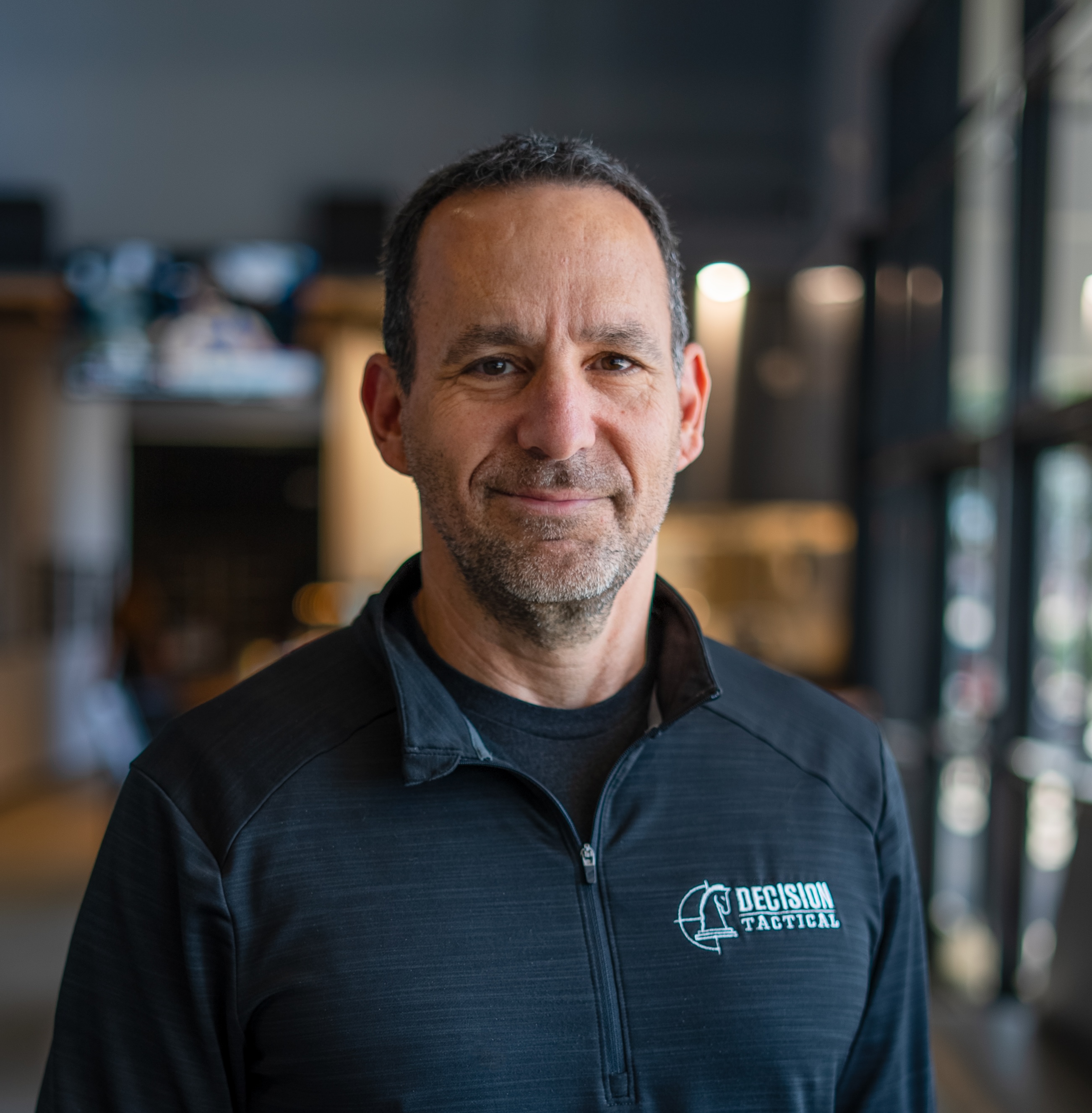
CEO and Co-Founder of Decision Tactical
Remo Eyal is the CEO and Co-Founder of Decision Tactical, an immersive training and decision-readiness company built on the principle that the simulator should adapt to the training—not the trainee adapt to the simulator. Before founding Decision Tactical, Eyal practiced law in Washington, D.C., and built and exited two successful businesses. His career spans law, entrepreneurship, technology, and complex problem-solving. He is an inventor and co-inventor of U.S.-patented technologies and has contributed to research and consulting initiatives for the U.S. Department of Energy and National Renewable Energy Laboratory. Eyal earned his J.D. magna cum laude from Georgetown University Law Center.